the terror of gay marriage: my favorite love story of 2012

Ever since reading Zadie Smith’s essay “Joy” in the New York Review of Books (if you read no other link I post, read this one), I’ve been thinking about her definitions of joy and pleasure and how each relates to love.

Smith begins:

It might be useful to distinguish between pleasure and joy. But maybe everybody does this very easily, all the time, and only I am confused. A lot of people seem to feel that joy is only the most intense version of pleasure, arrived at by the same road—you simply have to go a little further down the track. That has not been my experience. And if you asked me if I wanted more joyful experiences in my life, I wouldn’t be at all sure I did, exactly because it proves such a difficult emotion to manage.

(I so love how she essays.)

I’ve been thinking about my dog, Roscoe, who is my most regular source of joy, which Smith describes as “that strange admixture of terror, pain, and delight.” I was nervous about this when I decided to adopt Roscoe: that committing to care for and, by inevitable extension, to love another creature would open me up to all sorts of uncomfortable risks. I rationalized this to myself by hoping that by the time Roscoe reached old age, I’d have a child, and this child’s existence would somehow make the death of a dog more bearable.

roscoeporch5

Maybe the timing was right for contemplating my dog’s mortality because on the morning I read Smith’s essay, Roscoe had awoken with a cough. He’d never had a cough in the three years I’ve had him, and when you wake late with a foggy, New-Year’s-Day headache and hear an unfamiliar deep hacking sound, you can’t help but panic. At first I was sure something was caught in his throat. I had no idea what it could be or how it might’ve gotten stuck there during his sleep but I nonetheless pried his jaws wide and shoved my hand in. Sticking your fingers down a dog’s throat must be an act of love. That tongue is the same tongue that licks dumpster juice off the pavement on rainy mornings. That is the mouth that chews chicken skin and cat feces with equal gusto.

I don’t know why, if it makes my heart shudder to hear my dog cough, I’ve ever imagined it would be a good idea to have a child. My relationship with Roscoe is mostly uncomplicated. He eats and sleeps and walks and gnaws on a cow femur. And I sit on the floor by his mat when I have papers to grade so he will rest his chin on my lap and make the work just slightly less tedious. Sometimes I ask Roscoe if he loves me, and he responds to the over-emphatic, joyful tones of my voice with a floor-thumping of the tail. Surely, it is not so easy to trick a child into such a display of love. Even now, with my sister and me well into adulthood, our family holidays accurately reflect Smith’s picture of joy: there is a small measure of pain, and terror, and delight.

It seems that joy, by its very nature, must contain the possibility of loss. And the greater the risk, the greater the joy. Smith’s distinction between joy and pleasure reminds me of the distinction Continue reading
irony and the problem with online dating

I am in love with my friends. I mean this not in the if-you-love-them-why-don’t-you-marry-them sense, but as much as one can be enamored with the person who roasts Friday chicken just because you like it, or books the Stanley Park Christmas Train for the night you’re free to join, or checks in to see how you’re feeling since you sustained a minor yoga injury over the weekend, or picks up the tab for beer and charcuterie, or any other number of small but persistent kindnesses. I just adore them. And–whew–it’s a relief to get that all down, because I know it is uninteresting to praise one’s own friends, but I don’t care.

I just read this article in the New York Times: a challenge to live without the hipster irony that sometimes seems to define our era. My friend Erin says, “Who would want to live without irony?”and I think she’s right. Irony is fun. It’s funny. People who are wholly sincere (I’m referring to you, family in matching hand-sewn organic bamboo pants) tend to seem dull and out of touch. But, because I tend to drift from irony to sincerity, I’m excited about a potential shift toward earnestness. For example, there’s the time I interned for National Geographic Kids and started (ironically) e-mailing my friends links to stories of unlikely baby animal friendships (this stuff is NG Kids’ bread and butter), only to discover a few months later that I’d developed full-blown and mildly embarrassing baby animal infatuation. That and I think the joke “What did the zero say to the eight?” is genuinely funny*. And, yes, I really liked the new Footloose.

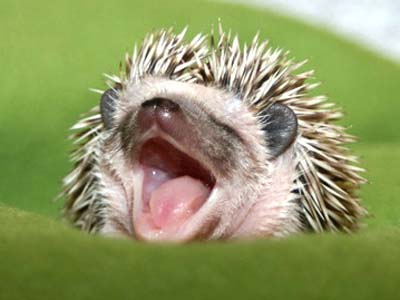
figure one: 18 day old hedgehog (note adorable absence of teeth)

When I was sitting in a cafe last week, the guy sitting next to me–having spied this article on my computer screen–struck up a conversation about relationships. Was it something I was studying, he wanted to know, and what was the most interesting thing I had learned? (The latter question I tried and utterly failed to answer–something I should work on.) We talked about marriage and love and dating and, eventually, online dating and he said, “It always unnerved me how much it feels like shopping.” I thought of my own experiences with online dating. “That’s kind of what I like about it,” I said. “It seems so efficient.” There was something about clicking from profile to profile that always gave me this sense of control over my own destiny. But I’m beginning to think he’s right, that the problem of online dating–which sometimes seems like the only way to meet people in notoriously-unfriendly Vancouver–is its similarity to selecting a new pair of earbuds on Amazon. And what got me thinking about all this are those generous, smart, interesting friends of mine, but bear with me–I’m getting there.

When I started online dating I got exactly what I needed, which was to discover–after a decade committed to one person–that there were funny or interesting or attractive people who thought I was also funny or interesting or attractive. But I wonder if the reason online dating feels like shopping is that it is shopping, not for a product but for an idea, for someone who fits the narrative of who you imagine yourself to be. And the very format of online dating rewards irony over sincerity. Because the guy who opens with an intentionally-corny joke or the girl with the self-consciously-goofy photo will always scan better than the person who admits he’d like to get married soon and preferably to a woman who makes good lasagna.

Continue reading

meet the author

I’ve always been interested in other writers’ processes, but I was especially so when I first started writing, mostly because I found it reassuring to hear that there isn’t necessarily a right way to write. Some writers–like Tim O’Brien, who puts in eight hours every day, even on his birthday, even on Christmas!–make me feel like I’m destined for failure. Others–like Zadie Smith, who starts with the first sentence and writes every subsequent sentence in order up until the last one–remind me that some people possess an inherent talent that is utterly distinct from any inkling of talent I’m lucky enough to have (thus rendering her process more of a museum-calibre artifact than an actual how-to manual). In these cases, I am reminded that the best thing I can do is to show up to my writing desk with some persistence, however discouraged I may feel. And to play to my strengths, now that I’ve been writing long enough to begin figuring out what they are.

I want this blog to be a place to sift through material and ideas, but also a place to think through process. And, if I’m very honest, a place–however tiny–to anchor myself to the writing world, to put my name and ideas into (virtual) print, and to legitimize what I’m doing as a Real Writing Project. I thought two and then three times about posting this interview here, because it seems strange–very strange–to post an interview that I did for a literary journal on my own blog.

But then I thought, That’s what writers do–they talk about process in interviews. And then, It’s a good time to grow up and get comfortable with publicizing my work. It’s part of my job as a writer to find readers, and no one else is going to do it for me.

So, without further elaborate justification, here’s an interview I did for a really cool, new journal of creative nonfiction and visual art: Under the Gum Tree.

When and why did you start writing?

I started writing, really writing in a thoughtful and habitual way, when I was seventeen and working as a K-Mart cashier. Standing in one spot for eight hours scanning barcodes left me with a head full of chatter. It was almost painful, the noise in my head, and I discovered I could relieve it by writing. I did this whenever I could: on breaks, in the bathroom stall, at the register between customers. I wrote in tiny print on the front and back of the brown recycled-paper towels we kept at each register. I’m pretty sure my best friend still has a stack of letters I sent her while she was away working as a summer camp counselor, all written on brown paper towels.

the smitten

Exodus 12:12 goes like this:

For I will pass through the land of Egypt this night, and will smite all the firstborn in the land of Egypt, both man and beast; and against all the gods of Egypt I will execute judgment: I am the LORD.

It’s classic King James Old Testament; like every Gothic cathedral you’ve ever visited, it’s at once ornate and resplendent and petrifying.

Another good smiting occurs in Deuteronomy 8:22:

The LORD shall smite thee with a consumption, and with a fever, and with an inflammation, and with an extreme burning, and with the sword, and with blasting, and with mildew; and they shall pursue thee until thou perish.

The OT is full of smitings. Most notably the mid-night killing of all Egyptian first born sons. But a smiting isn’t always genocidal; it can apparently resemble certain STDs (or bathroom molds?), and includes curses, plagues, punishments, and pestilences of all variaties. Though the word smite has been used in other contexts, thanks to King James we usually equate it with a blow of Biblical proportions.

Reading these verses reminds me of a visit to Mamaw’s one-room Southern Baptist church. I must’ve been seventeen or eighteen–familiar enough with theology to be arrogant, young enough to be angry. Before baptizing my cousin’s new baby, the preacher made a call to the unusually-large crowd (most of which, in this tiny congregation, was my family) to consider God’s daily personal message to us. If our lives weren’t going as we’d hoped, he cautioned, if we were experiencing sickness or suffering, God was probably punishing us for a lack of faith. It was God’s elbows, nudging us back into his worship. I left boiling with anger at someone telling an already-impoverished community that they were sinners, that their suffering was deserved. But here it is, in God’s very own words (by way of a variety of scribes, politicians, and translators, of course).

Sesquiotica considers the word in all its etymologic complexity. Continue reading

on the dangers of kissing

Last night I fell asleep to the sound of my neighbors arguing. I don’t really know them, though they’re friendly on the rare occasion Roscoe and I meet them in the hallway. They are never noisy. Until last night, they were a practically invisible presence in my life. But when I heard her crying, the kind of crying you only do when you think no one is listening, when you find yourself in that strange, desperate place between love and frustration, I felt…sad and a bit sick.

I’ve spent the summer blissfully removed from that feeling. Even as I have tried to remember, to write about the moment J and I finally decided to move apart, I’ve failed. The dialogue sounds tinny, the tone melodramatic. All I could come up with was a single, strange image: the moment the ball breaks through the glass instead of bouncing off of it. Something broken, something changed that can’t be repaired. Maybe I can’t tell the story, I thought, because it just wasn’t as momentous as it felt. Because the argument was barely an argument, just a disagreement about how we’d spend our Saturday. And maybe I shouldn’t explain it, I told myself, because in the end isn’t it always the mundane that drives us apart?

Though I couldn’t even hear their words, the tones of my neighbors’ voices validated the feelings which just last week had seemed so distant and overwrought to me. I lay in bed reading and trying not to listen, and thinking how grateful I was not to feel like that.

I spent yesterday afternoon reading about the brain. The research on the literal, physiological chemistry of love is too complex for a single blog post. Several chemicals and neural systems are involved and new research is always amending what we think we know about the mysteries of the heart, which in fact all reside in the brain. But understanding a little bit about it helps us to understand a lot about how love stories function in our lives.

Neuron, by Roxy Paine

First there are mirror neurons, the cellular basis of empathy–at least that’s the most popular theory at present. They appear to be far more complex than most brain cells, which respond to a single frequency, sound, or image. The same mirror neurons fire when we pick up a mug to drink from it, when we see another person drink from a mug, when we think about drinking, and when we say the word “drink.” Some scientists believe mirror neurons explain why we love fiction, and, by extension, movies, songs, stories of all kinds. So it’s likely then that when we hear a midnight argument and feel a kind of unbearable empathy, that’s our mirror neurons at work. They’re why when, in Dirty Dancing, Patrick Swayze says, “No one puts Baby in a corner,” we grin goofily, as if he’s speaking those words to us. They might explain why we love love stories: our brains feel temporarily like we’re the ones in love.

Which brings me to dopamine. Continue reading

27,766 words

I’ve been away. And for good reason. I’ve been writing, not quite every day but almost. All those strands of thought I’ve spent the past two-plus years collecting are weaving together into an imitation of an honest-to-god manuscript.

At present, I’ve got exactly 27,766 words. If we’re being technical, I’ve got about a bazillion more words than that, but 27,766 is the number of words that fall in order, one after another, into sentences and paragraphs and pages. In Microsoft Word terms, that’s about eighty double-spaced pages. And while I’m happy, thrilled even, about this sense of forward progress, the evolution of a bunch of disparate passages into a single, coherent thing brings its own unexpected anxieties.

Mostly, I worry about being a woman writing about love. I try hard to be smart and unsentimental, to be honest in a way that occasionally makes me uncomfortable. But I sometimes wonder about being dismissed as a girl who’s writing for other girls about their favorite girly subject. I am well aware of how writing anything that falls within the sphere of domesticity (or, even worse, romance) can relegate a women to the genre of chick-memoir or win her the label of myopic navel gazer.

And I worry about how slowly I write. I have, more than once, spent hours on a just few sentences. I’ve had the idea of this book for four years now, and have been writing it for at least two and a half. I try to think of Marilynne Robinson, who published her first novel (the truly excellent Housekeeping, which you must read if you are at all interested sentences) in 1980, and her second, which won the Pulitzer Prize, nearly twenty-five years later in 2004. In fact, each of her three novels has won a major book prize. She is not prolific, but profound, I tell myself.

Once I’ve got that Pulitzer nomination under my belt, I too can be less anxious about tangible productivity. For now, though, I am my usual, cautious self. I do not trust my sentences. I third- and fourth-guess them. It is better, I think, to trust in the writing process (that is, showing up at the computer every day for as much time as I can manage) than to trust in my own words. If you think something is good, give it a couple weeks. Things change.

An odd by-product of being cautious in writing about love, and of training yourself to doubt your initial instincts, to let them sit awhile before acting on them, is that you may also become doubtful of your instincts when it comes to love itself. Continue reading

What should a person know?

Consider these words:

know

acknowledge

notice

prognosis

cognizant

acquaintance

They all contain the sound of n+o or its mutated echo. Each suggests the idea of acquisition, the filling of a space in the brain or the body. An encounter with a bit of information, an awareness, or—if we are lucky—with another person.

I love this about words: the ways they multiply and divide, their particular cellularity. Each of these words contains within it the same single cell: the PIE root *gno-.

I think of the Gnostics, the early Christians full of spiritual knowledge. I think of the power of information, what comes with knowing something and the choice to share—or not share—what you know. I think of the difference between knowledge and belief and wonder if it is real.

I think about the things I am compelled to know. Right now: pizza. I want to know dough. To be acquainted with semolinas and yeasts, and the temperature fluctuations of my oven. I want to acknowledge our stories, why we tell them, what they offer. I want to notice what makes a sentence ache to be spoken aloud by its reader.

When I think of the things I do not want to know, the list is longer. I realize that I am an agnostic at heart, against gnosis, attracted to the unknown, the not knowing. Lately, I just want to settle in there, to inhabit that comfortable, ambiguous space. I tell my students that I am more interested in their questions than their answers. Those budding engineers and scientists are confounded by a teacher who says, “Don’t write a thesis. Your job is not to prove something.” Their hard stares suggest they do not like me for this.

Not knowing reminds me of the name of Shelia Heti’s new novel: How Should a Person Be? It’s on my reading list for the title alone. I like a good, hard question.

“To know – and to present what we know as if it’s all we need to know – is deadening, really,” Dinah Lenney says about writing essays in “Against Knowing.” I wonder, is knowing itself sometimes deadening?

Continue reading

the problem of deservingness

It’s sunny in Vancouver.

That statement deserves its own paragraph. It’s sunny in Vancouver, and over the past few days I’ve been the recipient of much kindness: comments and notes and messages from friends that arrive without warning and make me wonder what I’ve done to deserve them. I’m crediting the sun.

I’ve been thinking a lot about this concept of deservingness. In class, my students and I discuss the ongoing conversation about student entitlement. We talk about the difference between deservingness and entitlement. What does the university owe you? I ask them. Who deserves high marks? They have lots of smart things to say about degree inflation, their immigrant parents’ expectations, the value of a number on a piece of paper.

But I also think about deservingness as it relates to love and love stories.

“You deserve to be happy,” my dad said to me once, when I confessed to him that I wasn’t sure if I should stay in my relationship.

“No I do not,” I snapped back.

What I was trying and failing to say was not that I thought I should be unhappy, but that I didn’t think deservingness was part of the equation when it came to love.

My friend Lisa’s award-winning essay about grief, living and dying, and happiness articulates a lot of the feelings I’ve had about deservingness but struggled to articulate. She talks about her father’s death, the addition of tumors, the subtraction of life. “Things are always being added, taken away,” she says.

And this is just it: Life gives us what we get. Regardless of what we deserve. Continue reading

make good art

Today my dog is sick. My apartment smells like spearmint-scented cleaner and dog poop. And I can’t leave. Or I can but I won’t because I don’t want to clean up after a sick dog twice today. So here I sit on the couch, summoning olfactory fatigue.

Confined as I am, I decided to jumpstart my creative process with a little inspiration. Typically, I am wary of advice and I’ve long suspected that anything created with the sole purpose of being inspirational is, by definition, uninspiring. I’m thinking of the books we kept on our coffee table when I was kid: Don’t Sweat the Small Stuff (and it’s all small stuff) and All I Really Needed to Know I Learned in Kindergarten. I may tend toward optimism at time, but even the titles of these books make me want to scream. All the stuff is not small! Some of it is big. And terrible.

You know what inspired me to become a more-relaxed person? The Big Lebowski. Oh man! I thought to myself the night I first watched the movie, I am so very un-dude. And then I put some real effort into doing something about it. It’s a beautiful example of something that is inspirational not by design, but by default.

Because I respect you, I will not post a youtube video of, brace yourself, All I Really Needed to Know I Learned in Kindergarten: The Musical. But I will warn you: If you are curious enough to google it, wait for a day when your apartment does not smell like dog shit. One’s stomach can only bear so much.

Still, I was inspired while sitting on my couch today. And I thought it was worth sharing. It’s a long video, but if you have time–or if you are stuck on your own couch–one that’s worth watching. Yes, Neil Gaiman’s commencement speech was written with the intention of inspiring a room full of art students, but he never sacrifices honesty for simplification.

In case you’re on the fence about watching, here is, from my purple love seat, the bit I like best today:

Remember whatever discipline you’re in […] whatever you do, you have one thing that’s unique. You have the ability to make art. And for me, and so many of the people I’ve known, that’s been a lifesaver. The ultimate lifesaver. It gets you through good times and it gets you through the other ones. And when things get tough this is what you should do: Make good art.

Now I’m going to try to make some art. If it some of it is good, even better.

Bon Iver, dopamine, and Neruda’s wives

Last Friday night I saw the Bon Iver show at Deer Lake Park. It was my first warm summer evening in Vancouver, and I was feeling simultaneously happy and sad in that wistful way one inevitably feels as the sun sets over a lake and the sound of a nine-man band—including two full drum kits!—echoes through the leafy branches. The experience has gotten me thinking about the things that move us.

Take this, for example:

When Justin Vernon’s voice cracks as he sings “Now all your love is wasted? Then who the hell was I?” it just nails me. Shirt to skin to sternum to aorta. Over the past five days, I’ve probably listened to “Skinny Love” twenty or thirty times. Because I want to understand something about the aesthetics of love, something about how a song or a poem or a love story can make us feel, and something about the legitimacy of that feeling.

I’ve always thought that the difference between love (of the regular affectionate variety) and romance (the more spectacular, dreamy kind), was an aesthetic difference. My most romantic memories seem to be predicated on the beauty of a particular moment: The empty pebble beach, the gleaming Aegean Sea, and the limestone cliffs. The setting is so aggressively beautiful that if you visit it with the man you love, it is not possible to care who did or did not wash that morning’s dishes. That’s romance: He is the landscape. So are you.

What is both powerful and problematic about love songs is that they make us feel like we’re the ones on the beach, when in actuality we’re living another person’s romantic moment vicariously. Love songs annihilate any suspicions we may have that our feelings don’t matter, that they are only atoms organized into neurons that shoot chemicals across our brains. Continue reading