simply dig: thinking about the stories we tell ourselves

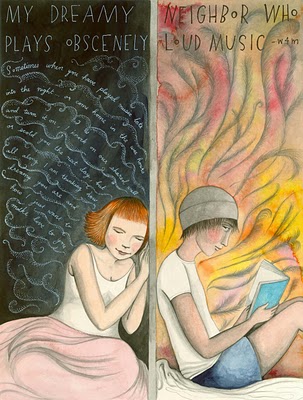
As I’ve indicated in earlier posts, I’ve been thinking a lot lately of how and why we tell our own love stories. And as I write, I keep coming back to a particular moment.

The night before my college graduation, J came to visit. He was not my boyfriend then. I had not seen him in a year and a half.

Four of us were sleeping in my dorm room that night: me in my bed, my roommate Katie and her soon-to-be husband Joel in her bed, and J on the floor in a sleeping bag. After a celebratory dinner with all of our parents, after settling into our respective spots sometime around midnight and turning out the lights, I realized I wasn’t going to sleep. The person I’d spent the past sixteen months dreaming about was in my room, and I could hear him shifting, still awake, the rustle of his skin against the nylon bag. Every dream I’d had about him been the same: his body next to mine under the duvet, his chin against my clavicle, the weight of a leg pressed upon my abdomen. And each time I’d wake up angry. Angry with the duvet for covering only me. Angry with myself for wanting him there. But then he’d written a letter saying he was coming to visit. This person who hadn’t even attended his own graduation wanted to come to mine. This person who I thought I’d never see again was lying on my dorm room floor.

I knew I should sleep—my family was arriving at eight the next morning—but instead, I stood up and whispered to him, “Do you want to go for a walk?”

We spent the night wandering the campus. He told me about his mud house in the Andes, about how he passed the days hiking through the forest above his home, about amoebas, about weeks of eating only rice and eggs and beans. And for the first time I could see that I’d been living in his past, in the life he’d left behind. What could he care about the ordinary world I still inhabited? The content of my letters, which before had seemed mundane, now also seemed childish.

So when we were sitting on the track sometime before dawn and he said, “I think about you, a lot,” it felt like someone had dropped a rock on one side of the scale in my stomach. And that mantra I’d been chanting—”Grad school in Florida. Grad school in Florida.”—just slid off the other side. It was the mantra I’d been using to steady myself, to remember that his visit was just a visit, not an opportunity to get distracted from the exciting new life I’d worked so hard to arrange for myself. But even in my unbalanced state, I remember thinking: this will make a good story someday.
Continue reading

the head and the heart: a valentine to the brain

One of the best things about writing (publicly) about love–and I think I’ve said this before–is that people send me love stories. They send me articles and images and videos, and I have not yet gotten tired of receiving them.

On Valentine’s Day in particular love stories abound, and they run the gamut from saccharine to sad; some are so full of the right kind of sweetness that my eyes go glassy on the bus ride home from work, and others are more like the middle-aged couple beside me at the bar tonight who dedicated their dinner hour to some heavy hand-holding. Later, I was unsettled to find them standing beside my bicycle and making out in that slow-yet-aggressive way that includes certain unconscionable suction noises that neither my loud jokes nor my flashing LEDs could modify.

For most of today, I was content to read the love stories, the one about the nun and the monk, the letter from a wife to her husband’s student, the photo essay of marriages that survived half a century, even the dog and the box of chocolates. But on my bus ride home, tear-ducts prickling as I listened to yet another love story (what is it with tears and transit?), it occurred to me that one who keeps a blog about love stories–and receives them via e-mail and reads them in between classes–ought to post a Valentine, even if at the eleventh hour. So here it is, friends, the most lovely of love stories I saw, read, or heard today (collected both on and off the bus). It includes lots of beeping, whirring and mechanical noises, but no suctioning, I promise.

This is ostensibly a story about science (though the science itself seems a bit shaky, even by the researcher’s own admission). What really got me, however, was not the data gathered from the subjects, but the participants’ post-experiment radiance, their astonishment at their own capacity for love. After just five minutes spent meditating on a loved one in an fMRI machine, even those most infatuated seem to surprise themselves, as if the machine stuffed the love into their brains rather than measuring what was already there. By internet standards, it’s not a short video–about fifteen minutes long–so wait until you’re settled on the couch (or bus seat, as the case may be) with a bottle of beer and a dog at your ankles and a few minutes to yourself. It’s worth the watch, even if–especially if–you haven’t spent your day doing any heavy hand-holding.

the power of a deadline

I decided to enter the CBC’s Canada Writes Nonfiction Literary Competition this week. Immediately, there were two problems with this decision: One, I first heard about the competition five days before the deadline. And two, the regulations included an unusual word count requirement: 1200-1500 words. Ordinarily, writing competitions or journals give writers a maximum word count, but rarely do they give a range. And if they do give a range, it’s rarely so narrow. A full-length essay usually falls between 3000-4000 words. A short-short–or flash–essay, an increasingly popular form of nonfiction, typically has an upper limit of 700-1000 words. Of course, 1200-1500 words is a lot like the length of a blog post, but blog posts–or anything self-published for that matter–were strictly disallowed.

Because I started teaching a new class this week (and, yes, because I needed to go to the climbing gym and to a movie and to a beer tasting event), I didn’t have the chance to start cobbling together a submission until about two days before the Wednesday-at-midnight deadline.

And this is the power of a deadline. I spent about five hours on Wednesday trying to turn a 900 word piece into a 1200 word piece and somehow, right at the last minute, what had been a pretty good scene became something bigger and more interesting. It was a scene that I thought might fit into my book, but probably won’t, a scene about the first time J and I talked about love. Adding another 300 words forced me to ask myself a lot of really useful questions:

What are the power dynamics involved in asking someone if they love you? Or in telling them that you love them?

How can I write about someone I spent ten years of my life with, a relationship that I still have lots of unresolved and complex feelings about, in a way that is fair to both of us?

And why do I keep coming back to this scene, to the two of us at twenty, lying on his old lumpy futon and talking about love? What is it that matters about that moment?

I really like this post by Shanna Mahin in defense of the memoir. In response to the criticism that memoir writing is some kind of misguided attempt at self-therapy, she writes, “If I can come from a place of honesty and love, I might be able to tell a personal story that resonates on a universal level.” And I like Jennifer Bowen Hicks’ argument that an essay should be like “an earnest whisper in another’s ear—how brave. Put away thoughts of black lace and sordid secrets. The sort of whisper I mean can be about hummingbirds or athlete’s foot, an aging parent or eggplant. Its very purpose is not to show, but to say, and by saying to connect.”

I have understood for some time that when it comes to my own love story, my position is the more sympathetic one. I wanted it more. And when it comes to love, we identify with the one who wants the relationship more. The pain of the lover is always deeper, more acute, more compelling than the pain of the loved. Of course we were both lovers and we were both loved, but the story, as I cannot help but tell it, inevitably contains my belief that I wanted it just a little bit more. I was attracted to J for his independence. I loved that he was like no one else I knew. He was (still is) insistently nonconformist. I wanted to be someone who was unafraid to move alone to a village in the middle of the Andes. But since I could not be that person, I decided to fall in love with that person instead.

Continue reading

reading the missed connections

Last week I stumbled across a series of illustrations inspired by craigslist Missed Connections:

They’re by artist Sophie Blackwell, and all are selected from the New York City craigslist. I love how her prints capture the near-universal experience of unrequited love and secret crushes, but also our uniquely contemporary ability to broadcast those affections to a larger audience. It’s the adult equivalent of the middle school trick where you tell a friend to ask your crush’s best friend if he also has a crush on you. If no news comes back, you’ve saved yourself the embarrassment of rejection, but, hey, at least you gave it a shot.

When I worked as a barista at a popular coffeeshop in Washington, DC, I sometimes read the Missed Connections. My coworkers (who were an admittedly attractive and charming group) were frequent subjects of unspoken affection. But that was years ago, and in the intervening time, I’d kind of forgotten about that corner of craigslist. So I opened the Vancouver page to see what kind of stories I might find there.

Blackwell’s world is fully of mostly-young, mostly-white people who read Bukowski on the subway and have funky, furry hats and cool tattoos. Their affections are quirky and intelligent, and they write with the dreamy tone of the truly smitten. Their desires are wholesome and decidedly un-creepy. They want to buy someone a drink or say “thanks for smiling at me” or express a public regret for not saying hi. But a search of Vancouver’s missed connections turns up a more complex, slightly darker world. Continue reading

which came first: love or the love story?

I was sitting at my writing desk, about a year after my parents split up, when the pictures I’d taped on the wall above me caught my attention. There were four photographs:

J and I at our friends’ wedding: We were twenty-two, dressed up, slow dancing in the grass, sweating in the humidity. He grins broadly. My eyes gaze into the camera, glinting in the Tennessee sunlight. Our fingers are wrapped around each others’ like we’re afraid a great wind might come up and sweep us apart. What I remember most about that day is how, just before they cut the cake, he’d grabbed me and whispered in my ear, “You look beautiful.” He’d never said anything like that to me before. I don’t think anyone had. Because he lived in Ecuador at the time, and because I was just about to move to Florida, we’d been working hard to convince ourselves and the people around us that we were just friends. But when we were alone for a moment, he’d grab me and kiss me, like he was memorizing my mouth for the months ahead. They were the kisses I’d spent my adolescence dreaming about. I don’t remember being kissed like that before or since. Looking at the photo, I can see how blatantly our act must’ve failed. My round, red cheeks betray us.

The house I grew up in: It sits atop a small ridge. Brick with three dormer windows and a wrap-around wooden porch, it was my mother’s dream house. The green lawn is freshly mown with the perfect diagonal stripes of a baseball field. The sky is cloudless blue and the pear tree, its trunk just out of the frame, is a burst of white confetti blooms. Looking at the photo from our tiny one bedroom apartment in Vancouver, I could see, for the first time, the indulgence in such an expanse of property–three acres and four bedrooms. But from Vancouver, I couldn’t see the half-furnished rooms or the for-sale sign staked in the grass by the road. I couldn’t hear the way the tv echoed off the pine floorboards. From three-thousand miles, it looked like a kind of pastoral paradise with antique rockers on the porch and a dog lazing in the grass.

My parents at the prom: My dad was a chaperone again, twenty years later, but this time as a high school principal. Mom stands just in front of him in a black dress she borrowed from my closet. In perfect prom-photo style, his palm rests on her elbow; her hands are neatly clasped. Beside the piano, standing on an antique Persian rug, they are a handsome couple.

A postcard of a sculpture by Auguste Rodin: Two stone bodies against a black background. A man lifts a woman above his chest. I bought it in Paris, years ago, at Musee Rodin.

In Rodin’s Je Suis Belle, a man hoists the crouching, compact figure of a woman toward the sky. His every muscle is tensed, in exhaustion or ecstasy I can’t decide. She is delicate, almost inhuman with her frog legs pushed up into her abdomen. One arm hangs down, pinned against him. Her face turns away from his as he bears the entire weight of her body on his chest. His knees bend, his buttocks ripple. I wonder, is he bringing her down from the hands of God or offering her back up?

And I wonder why this image? Why these lovers? Why not Rodin’s The Kiss, a more popular, more conventional scene: a man and woman in a passionate embrace? What stories of love had I surrounded myself with? Or, was each image just another version of the same story?

I used to believe that the problem with my own relationship was that I expected it to look like my parents’ relationship–and it never would. But when they split up, I was suddenly free from that expectation. Here were two people who seemed to have done everything right, and they still couldn’t make it work. So maybe it didn’t matter that we kept making mistakes. A couple of months later, J and I moved in together. I remember those first weeks in our tiny apartment, walking around and saying to each other, “Isn’t this a happy home?”

Continue reading

another kind of love story: sex and writing

When I was twenty-two I attended a writing workshop with Percival Everett, who asked us to write a sex scene. It would take longer than we thought, he warned, so we were all to head back to our rooms and get started. The next day in workshop we would read them aloud.

I spent that entire afternoon holed up in a white-tiled, airconditioned dorm room in the flattest part of Texas, staring blankly at my computer and willing my fingers to type something. Every sentence I found myself fighting off weird analogies and echoes of bodice-ripping romance novels.

Everett bellowed his deep, echo-y laugh whenever someone’s writing amused him, and I made it my goal to make him laugh. If I could make him laugh, I reasoned, the class might not notice how my face had turned beet red because I was reading a sex scene. That I wrote. Which meant I knew something about sex (which was better, I guessed, than knowing nothing). But I was twenty-two and from a rigorously-puritanical part of the world, where people didn’t talk about sex in private much less in public. I was also the youngest, whitest, most apparently-vanilla person in an otherwise diverse group. If I’d been able to hide how much I felt out of my league before the assignment, I was sure it’d become apparent quite quickly after.

Eventually I realized my problem: I was trying to write a love scene, not a sex scene. Once I took love out of the equation, writing about sex became a lot more do-able, and even fun.

I am thinking about this now because I spent the weekend trying to write a description of a man’s body. Not a sex scene, but a kind of inventory of another person. I wanted to articulate the physical-ness of him, the topography of his skin, the way you can love someone simply for how they exist in space. But it was a disaster. Saccharine and flowery and utterly un-subtle.

I’m a firm believer in attempting to eff the ineffable. After all, that’s why we created metaphor. But some things, like sex and love and the body, will always be kind of elusive. My friend Lee posted this video on facebook. I haven’t seen the entire movie, but I was charmed by this clip–a fairly SFW sex scene–and inspired to keep eff-ing:

avalanche stories

“It’s like skimming cream off the top of fresh milk,” J says. As he says this, he pivots on the balls of his feet, turning his heels from one side to the other, bending his knees with each turn and stabbing the floor with an imaginary ski pole in a perfect marching rhythm. On his face is this strange, faraway grin. He’s left the living room and is floating down a fresh powder slope, leaving a perfect single-helix trail in his wake. Laying trenches, the boys call it. They look at the snow forecast and giggle like school girls.

Powder skiing is what my friend Kirsten would call type-1 fun. Like dancing ’til dawn or playing with puppies or eating my dad’s pulled-pork barbecue, every moment of a type-1 fun activity is intensely pleasurable. Type-2 fun typically denotes things that you don’t necessarily enjoy in the moment, but that you can look back on and say, “Oh yeah, that was fun,” things like camping in torrential rain or traveling by bus in some parts of the developing world. (When googling the term I found a blog that put it succinctly: “When you engage in type-two fun, you’re investing in your future self.”) But powder skiing, once you learn to make even two or three turns without bailing, is addictive, hypnotic. The satiny float of your skis on the snow, the momentary weightlessness as you straighten your legs. You crave it. The dopamine levels in your brain rise just thinking about it. And you find yourself engaging in all kinds of type-2-fun activities just to experience it.

type-1 fun

I took my first avalanche safety class last February, primarily because of a dawning awareness that I needed access to more powder skiing. An avalanche safety class, especially on a day when the dumping gray snow obscures the tops of trees and soaks through to your long johns, is definitely type-2 fun. But I was up for it. The year before, my roommates–the boys who had titled our wireless network “powderhounds”–had spent the winter sniffing out the fresh powder in the British Columbia backcountry, and now I wanted in.

Continue reading

Something about how this started

I have this theory that most love stories actually do a terrible job of preparing us for the business of being in a romantic relationship. But despite this, we still love love stories. We tell them all the time. We hold them up to the light next to our own relationships.

I love love stories. Personal experiences, family histories, fairy tales, cheesy romantic comedies–you tell it, I’ll listen. Cue up a Julia Roberts movie and I’m the one sitting beside you on the trans-Atlantic flight, glancing surreptitiously at your iPad and pretending my red, puffy eyes are the result of cabin pressure and a pretzel allergy.

I once worked at a writing center with a Joan Didion quote on the wall that read, “I write entirely to find out what I’m thinking, what I’m looking at, what I see and what it means. What I want and what I fear.” I’d been writing essays about rock climbing, or caffeine, or medieval martyrs, but somehow each piece snuck back around to this one fact: I fell in love.

Every day I looked at that quote and I grew increasingly worried about what it might mean for me. Love scares the crap out of me, but somehow I’d spent my life wanting it. If I didn’t tackle it head-on, I might never stop writing about it. I was used to being good at things, but love? Love was too smart for me. It was the roadrunner and every time I tried to catch it, I threw myself off the cliff with the anvil. I wanted to know why love wasn’t easier. And why something that was a fundamental biological drive could feel so utterly unintuitive.

Well, I for one blame the messenger. Love stories, you’re in my sights.

One day, this will be a book. In the mean time, it’s a hot mess of Word documents, and, now, a blog!